
REVIEW · GUIDED
Explore Bucharest Step by Step With A Local Guide
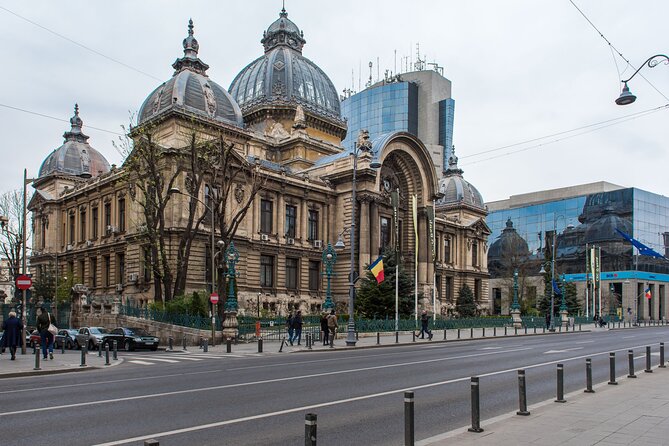
Bucharest makes sense when you walk it. I love how Revolution Square frames the end of Ceaușescu and Romania’s pivot away from communism, and I love how Doina (and guides like Dorin) turn each stop into a clear, street-level story you can actually remember. The only real drawback is the pace, many sights get about 10 to 20 minutes, so you will want to linger if one place really grabs you.
This tour has strong value because the listed stops have free admission, meaning you are mostly paying for the guide, not for entry fees. You also get a mobile ticket, which keeps it simple on the ground. Starting near public transportation helps too, especially if you are juggling buses or metro between neighborhoods.
You end at Piața Constituției, facing the Palace of Parliament area, which is a striking way to finish a walk that starts in revolution and ends in modern power symbolism. It runs in English and is sized for up to 10 people, and there is a good weather requirement, so keep an eye on the forecast.
In This Review
- Key highlights you should care about
- Revolution Square, where a revolution ended and a new era started
- Calea Victoriei, Bucharest’s ceremonial avenue and its candle-lit past
- University of Bucharest, a classic landmark with a city-scale purpose
- Macca Villacrosse Passage, a small arcade moment in the Old Town
- Stavropoleos Monastery, Eastern Orthodox calm with 18th-century roots
- Hanul cu Tei and Manuc’s Inn, Bucharest’s preserved historic inns
- Piața Constituției and the Palace of Parliament, finishing with scale and meaning
- How the tour feels in real life: pace, group size, and guide energy
- Price and value: why $16.87 feels fair for a guided Bucharest route
- Best for first-timers, history curious walkers, and people who want structure
- Should you book this Bucharest step by step guided walk?
- FAQ
- How long is the Bucharest Step by Step with a Local Guide tour?
- What is the meeting point and where does the tour end?
- What time does the tour start?
- How much does the tour cost?
- Is the tour offered in English?
- How large is the group?
- Are there admission tickets required for the stops?
Key highlights you should care about
- A guided route that connects politics to everyday streets, from revolution sights to Old Town passages and historic inns
- Short, focused stop times, great for orientation, but you may want extra time on your favorites
- Monasteries and hidden-in-plain-sight architecture, like Stavropoleos and the Macca Villacrosse Passage
- Historic inns still preserved in character, including Hanul cu Tei and Manuc’s Inn
- Palace of Parliament views built into the walk, so you finish with context, not just a photo stop
- Guide energy and problem solving, with help finding practical spots when you need them (even with a stroller)
Revolution Square, where a revolution ended and a new era started
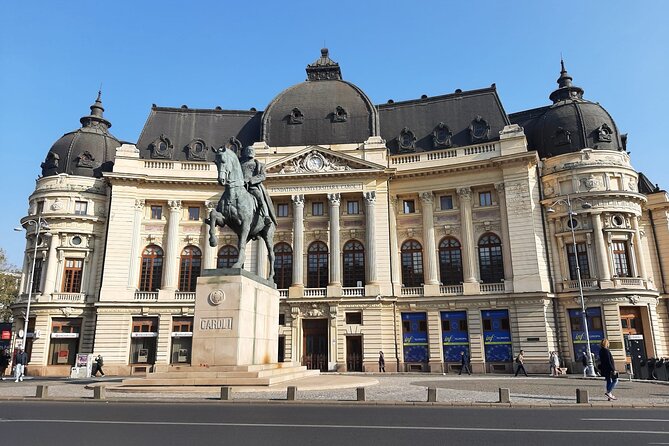
Start at Piața Revoluției and you immediately feel the weight of place. This is where Ceaușescu’s last public speech took place on 21 December 1989, and where the crowd revolt quickly escalated, helping end the communist regime. You are not just looking at buildings. You are standing inside a timeline.
A good guide helps you sort what you are seeing from what you are imagining. I liked the way my guide pointed out the emotional logic of the square, why it became the turning point, and how that moment rippled into street life afterward. If you come to Bucharest thinking it is only about palaces and cafés, this stop corrects that fast.
What to expect: a short stop, about 20 minutes. That is enough to get oriented, read the atmosphere, and understand why later stops make sense. What could feel limiting: if you are the type who loves long speeches and museum-style context, you might want more time, because this is built for walking, not for sitting with documents.
Calea Victoriei, Bucharest’s ceremonial avenue and its candle-lit past
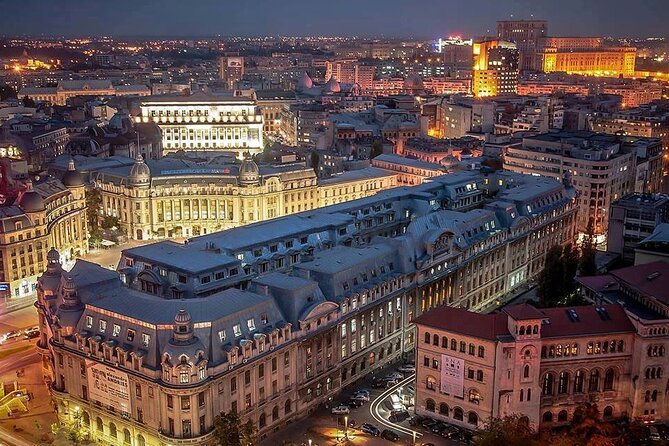
Next, you move onto Calea Victoriei, Victoria Avenue. It is one of Bucharest’s oldest roads, and there is a specific detail that makes it feel less like a random boulevard and more like a staged corridor of city pride: it was the first Bucharest street illuminated with candles at night, beginning in July 1814.
That candle detail matters because it explains why the avenue became a spine for important city life. Even if you are not into lighting history, you will understand the vibe. This road was meant to be seen, and to show order.
About 20 minutes here gives you enough time to walk the width of the idea: grand facades, the sense of an avenue built for prominence, and the way streets in central Bucharest still shape how people move through town. The tradeoff is that you will not get a deep architectural tour on foot, but you will get the right narrative so you can spot meaning later when you explore on your own.
Guided, and already checked
University of Bucharest, a classic landmark with a city-scale purpose
The tour then pauses at the University of Bucharest. Even with only about 10 minutes, this stop works because the university building is one of those emblematic landmarks that helps you “read” the city. It signals education, permanence, and a different kind of public life than the revolution square.
When a guide treats it as a marker in the route, you start to understand that Bucharest’s main streets are doing multiple jobs at once. They move people, they project values, and they connect neighborhoods.
Practical note: this part of the walk stays quick. If you are hoping for an exterior-only photo sprint, you will be fine. If you want interior access, the time and format likely will not support it, since the tour is designed around orientation stops.
Macca Villacrosse Passage, a small arcade moment in the Old Town
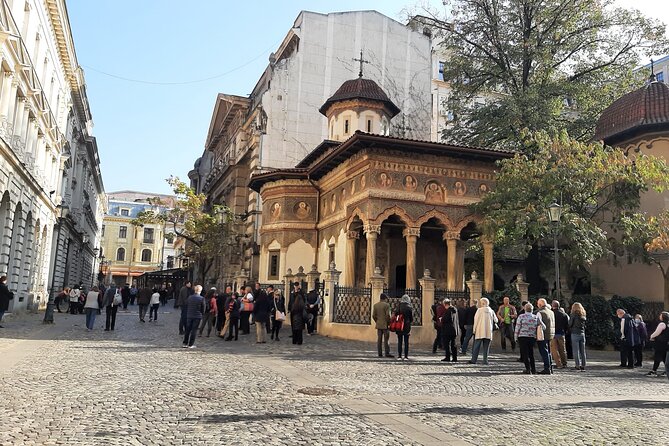
Then you get a change of pace into the Old Town atmosphere with Macca Villacrosse Passage. This is described as a mini Vittorio-Emanuele gallery, and you can feel why. It is the kind of narrow, covered passage that gives you a different Bucharest texture: more intimate, more “wanderable,” and built for strolling when the street feels too open.
A 10-minute stop sounds short, but it is a smart length for this kind of place. The passage is a visual you absorb quickly, then remember later. You are learning what to look for in Bucharest’s hidden corridors without turning your half day into a scavenger hunt.
Potential drawback: if you arrive during a busy moment, it can feel more like walking through foot traffic than exploring, since passages naturally funnel people. Still, the guide context helps you appreciate why this kind of space exists.
Stavropoleos Monastery, Eastern Orthodox calm with 18th-century roots
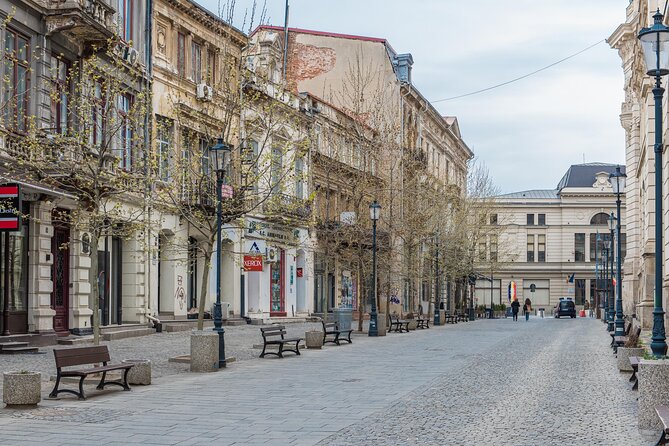
Stavropoleos Monastery, also known as Stavropoleos Church, gives you something completely different. Built in the 18th century by a Greek monk, it brings you into Eastern Orthodox religious architecture and a quieter rhythm than the boulevards.
This stop is about 15 minutes, which is a good compromise. You get time to look closely, notice details, and understand the setting without rushing so hard that it turns into a checklist. A strong guide helps you make sense of what you are seeing, especially for first-time visitors who might not know the difference between a monastery space and a simple church visit.
What you should watch for: since it is a religious site, the experience is more about respectful observation than about casual sightseeing. If you want more time for photos or stillness, you may wish you had an extra block of minutes, because the walk keeps moving.
Hanul cu Tei and Manuc’s Inn, Bucharest’s preserved historic inns
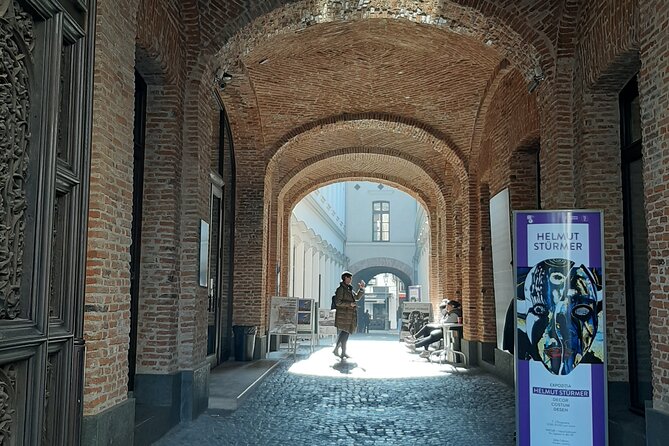
Two of the most charming stops come next: Hanul cu Tei and Manuc’s Inn (Hanul lui Manuc). These are not just “interesting buildings.” They are a window into how Bucharest used to do commerce and lodging, and why parts of the city can still feel practical and lived-in.
Hanul cu Tei is described as the only historic inn in Bucharest that has preserved its shape exactly as it was at its origins. That matters because it is rare. Many old structures get altered. Here, the point is continuity, so when you look at it, you are seeing something close to how it started.
Then Manuc’s Inn enters with even more weight. It is described as the oldest operating hotel building and the most important commercial complex in the middle of the 19th century. That is a big claim, and the way the guide frames it makes it believable. You start connecting the dots between trade, travel, and how Bucharest hosted business in its central core.
Time at each: about 10 minutes. That is enough to appreciate the structure and learn what makes each inn historically distinctive, but not enough to turn it into a deep study. The good news is that these stops are perfect for quick questions. I found it helpful when the guide could point out what to notice right away.
One practical bonus from the experience vibe: the guide style seemed built for real life. My guide was helpful with finding practical solutions when you need a restroom stop, and the walk works even if you are bringing a stroller.
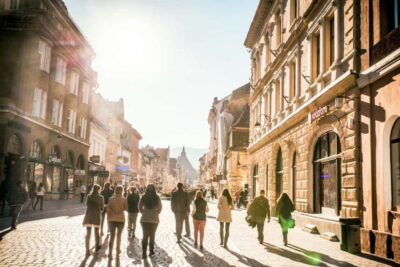
Piața Constituției and the Palace of Parliament, finishing with scale and meaning
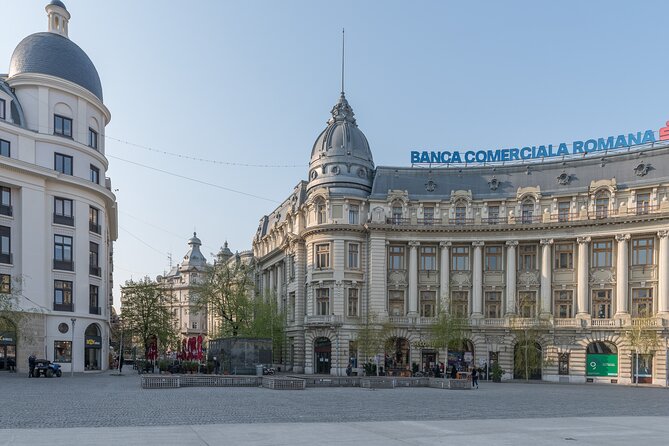
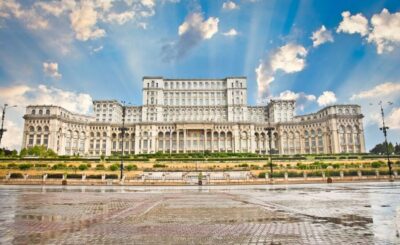
You end at Piața Constituției. From here, you face the Palace of Parliament, described as the second biggest administrative building in the world. Even if you have seen photos before, being there in person is different. The scale can feel unreal, and it changes the tone of your entire walk.
This is where the tour’s structure pays off. You start at a place tied to the end of communism. You move through avenues, institutions, and old passages. Then you finish with a monument to state power in a new form. The contrast is the point, and a good guide helps you see it as narrative, not just sightseeing.
Stop time is about 15 minutes. You will likely spend that time taking in the mass of the building and getting the context so your photos mean something later. If you are sensitive to crowds or just want calm time at the end, aim for the earlier part of your stop window, since your finish area can be busy.
How the tour feels in real life: pace, group size, and guide energy
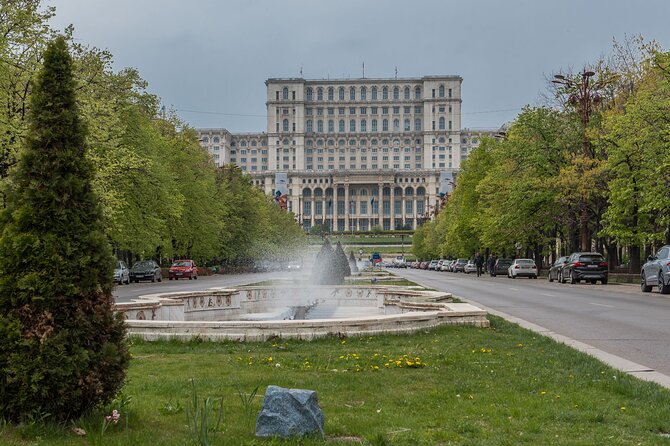
This is a walking tour with a 3-hour duration in the schedule, and it caps at 10 people. That size is small enough to ask questions without feeling like you are interrupting, but large enough that the group still feels lively.
The big thing I noticed in the guide approach is how much effort is put into making the route legible. Guides like Doina and Dorin were praised for being enthusiastic and helpful, and you can feel that style in the way they connect the dots between stops. You are not memorizing facts for a quiz. You are learning what the city is telling you with its layout.
Also, the guide energy can stretch the experience. In at least one case, the guide went beyond the allocated time to show more and share more. So if you like asking questions and taking your time with explanations, you may get a bit extra value.
Where you might feel the limit is the stop tempo. With several 10-minute segments, you will see a lot, but you will not linger like you might on an all-day neighborhood stroll. If you are the type who wants to sit down for coffee at every stop, this route will feel brisk.
Price and value: why $16.87 feels fair for a guided Bucharest route
At $16.87 per person for roughly 3 hours, you are paying for a guided orientation plus a tight route across major sights. The standout value lever is that the listed stops have free admission, so entry costs are not inflating your total.
So what exactly are you getting for that price?
- A local guide who can explain why each stop matters, not just what it looks like
- A planned sequence from central revolution sites to Old Town spaces and historic inns
- A route that ends at a major landmark area, giving you a finished arc rather than random wandering
- A format designed for small groups and English speakers
Compared to doing it solo, you save time in two ways. First, you do not need to build the route yourself. Second, you get context so you can explore more confidently after the tour. It is not just transport. It is translation of the city.
Best for first-timers, history curious walkers, and people who want structure
This tour suits you if you want an ordered way to get your bearings in Bucharest. It has the big political anchor at Revolution Square, then it moves through key central streets and landmarks, and it finishes with the Palace of Parliament area. That arc helps you understand what you will see later on your own.
It is also a good fit if you are traveling with limited time. A 3-hour walk is long enough to feel like you learned something real, short enough that you can still do other activities the same day.
Finally, it works well for families who need flexibility. One guide was praised for helping with logistics like stroller access and for knowing local places where you could find restroom help. The stops are outdoors or exterior-focused, and the structure feels manageable.
Should you book this Bucharest step by step guided walk?
I would book it if you want a guided route that turns Bucharest from a collection of photos into a readable story. The combination of Revolution Square, candle-lit Calea Victoriei context, monastery calm at Stavropoleos, and the historic inns like Hanul cu Tei and Manuc’s Inn gives you variety without chaos.
You might skip it or pair it with extra time if you are the kind of visitor who needs long pauses inside sights. This tour is built for motion and orientation, not deep museum-style time. Also, if weather is miserable, plan for the fact it is noted as weather dependent.
My quick decision rule: if you like walking, asking questions, and learning the why behind what you see, this is a strong value way to start a Bucharest visit.
FAQ
How long is the Bucharest Step by Step with a Local Guide tour?
It lasts about 3 hours.
What is the meeting point and where does the tour end?
It starts at Piața Revoluției (Revolution Square) and ends at Piața Constituției (Constitution Square).
What time does the tour start?
The start time is 10:00 am.
How much does the tour cost?
The price is $16.87 per person.
Is the tour offered in English?
Yes, it is offered in English.
How large is the group?
The tour has a maximum of 10 travelers.
Are there admission tickets required for the stops?
All listed stops have admission ticket free.
Guided And Already Checked
- Bucharest: Palace of Parliament Tickets and Guide
★ 4.3 · 3,182 reviews - Bucharest to Dracula Castle, Peles Castle and Brasov Guided Tour
★ 4.5 · 2,933 reviews - Bucharest: Palace of Parliament Tickets and Guided Tour
★ 4.4 · 1,877 reviews - Bucharest: City Highlights Guided Walking Tour
★ 4.9 · 1,482 reviews - Bucharest: Salt Mine Guided Day Trip to Slănic
★ 4.6 · 559 reviews
Everything Else We Reviewed In Bucharest
- Bucharest: Dracula’s Castle, Peles Castle, & Brasov Old Town
★ 4.5 · 17,858 reviews - Bucharest: Dracula Castle, Peles Castle & Brasov Old Town
★ 4.6 · 10,891 reviews - Bucharest: Dracula’s Castle, Peleș Castle & Brașov Day Trip
★ 4.5 · 5,919 reviews - Bucharest: Palace of Parliament Tickets and Guide
★ 4.3 · 3,182 reviews - Bucharest: Day Trip to Dracula Castle, Peles Castle & Brașov
★ 4.4 · 3,049 reviews
Recently added around Bucharest
- Private Tasting Expedition Along Romania’s Most Famous Wine Route★ 5.0 · 3 reviews
- Private Guided Tour of Peles Castle and Bran Castle from Bucharest★ 5.0 · 3 reviews
- Private Sightseeing Tour of Bucharest★ 4.5 · 3 reviews
- Discover Europe’s Deepest Mines & Peles Castle’s Royal Charm★ 5.0 · 3 reviews
- Bucharest City Tour and Wine Tasting★ 5.0 · 3 reviews
Guided, compared.
 ★ 4.3Bucharest: Palace of Parliament Tickets and GuideFrom $383,182 reviews
 ★ 4.5Bucharest to Dracula Castle, Peles Castle and Brasov Guided TourFrom $332,933 reviews
 ★ 4.4Bucharest: Palace of Parliament Tickets and Guided TourFrom $281,877 reviews
 ★ 4.9Bucharest: City Highlights Guided Walking TourFrom $211,482 reviews
 ★ 4.6Bucharest: Salt Mine Guided Day Trip to SlănicFrom $56559 reviews
 ★ 4.4Bucharest: Dracula Castle, Peles Castle & Brasov Guided TourFrom $116323 reviews
 ★ 4.93-Hour Guided Tour of Communist BucharestFrom $29303 reviews
 ★ 4.7Sibiu: Daily Sightseeing Guided TourFrom $16247 reviews