
REVIEW · BUCOVINA
1-Day Bucovina Painted Monasteries tour from Suceava – English
Five monasteries, one unforgettable blue day.
This tour is interesting because you see some of Romania’s most famous 16th-century fresco churches in a tight, well-organized loop, without the hassle of parking or transfers. I really like the air-conditioned pickup/vehicle comfort, and I like the fact you’re usually the only passengers in the car. One thing to consider: entrance fees and lunch aren’t included, so you should budget a bit extra for tickets on site.
You’ll start at 9:00 am from your hotel or any Suceava address, then spend about 7 to 9 hours out in Bucovina. Expect a live English-speaking guide who can talk through art, architecture, and the region, and you might be lucky enough to get guides mentioned by name such as Bogdan or Gabriel (both come up for clear explanations and an upbeat, helpful style).
In This Review
- Key things to know before you go
- From Suceava: the comfort and flow that makes the day work
- Humor Monastery: hilltop calm and the story on the rock
- Voronet Monastery: the blue fresco people travel for
- Moldovita Monastery: fortress walls and Petru Rareș
- Sucevita Monastery: the best-kept painting and the Virtues Ladder scene
- Marginea Black Ceramics: a short taste of craft culture
- Price and value: where your money goes, and what to budget
- Pace, timing, and what to expect during the 7 to 9 hours
- Who this Bucovina day trip fits best
- Quick checklist before you book
- Should you book this 1-day Painted Monasteries tour from Suceava?
- FAQ
- Is pickup included for this tour?
- Are entrance fees included in the price?
- Is lunch included?
- How long is the tour?
- What time does the tour start?
- Can I get a full refund if I cancel?
Key things to know before you go
- Hotel pickup in Suceava means less stress the morning you leave.
- Only your group in the vehicle keeps the day feeling personal, not chaotic.
- Four Painted Monasteries plus a pottery stop gives variety without rushing.
- Each church gets about an hour so you can actually look, not just pose and move on.
- Parking is included, so you do not arrive thinking about extra small fees.
- Tickets are not included, so bring cash or card for entry and any small add-ons.
From Suceava: the comfort and flow that makes the day work
This is a classic “see a lot, without feeling harried” day trip. You get picked up for free in Suceava, and you ride in an air-conditioned vehicle, which matters in summer and still helps if the weather is warm but changeable. The route also keeps logistics simple, with parking fees handled for you.
What you’re really paying for here is time and clarity. Instead of piecing together transport between distant villages, you follow a guide who knows the churches and how to move you from one site to the next. The tour is listed as private for your group, so even though it’s a full day, it doesn’t feel like you’re trapped in a big bus herd.
The start time is 9:00 am, so plan to be ready earlier than you think. If you like slow mornings, grab coffee close to pickup time, not an hour before. The day will move at a good tempo, but the stops are long enough to breathe.
Humor Monastery: hilltop calm and the story on the rock
Stop one is Humor Monastery, set on a crest of a hill. The approach is part of the charm: you see trees and meadows, then you reach the exterior wall area where an inscription is carved in rock.
The detail that makes this stop more than a quick photo is the history tied to the site. The church dates to 1530, built by Toader Bubuiog, who was a chancellor and a member of the Moldavian Council. That short fact helps you look around differently. You start noticing how the church sits in its landscape, and why the location matters to the people who commissioned it.
You’ll have about an hour here, and it’s the right kind of first stop. You get your bearings, then later your eye can catch fresco details and architectural choices more easily. If you tend to over-schedule, this opening hour is also a mental reset before the more famous names like Voronet.
Entrance tickets are not included, so this is one of the moments to expect extra on arrival.
The painted walls, other itineraries
Voronet Monastery: the blue fresco people travel for
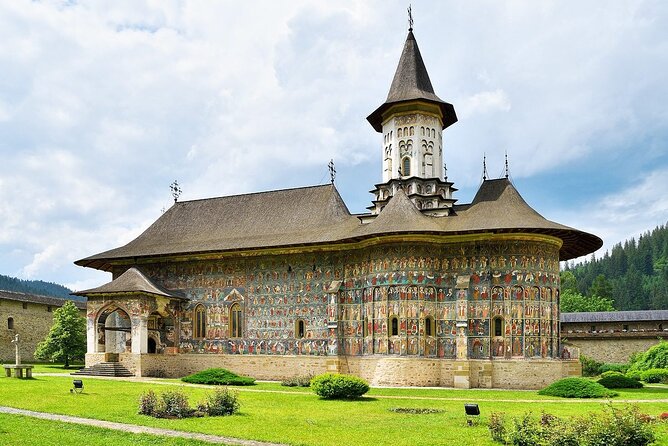
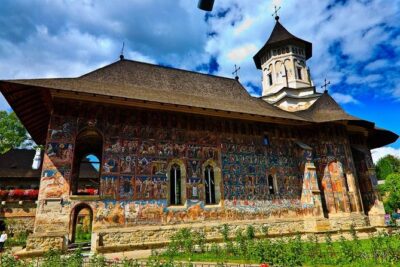
Next comes Voronet Monastery, and yes, it’s famous for a reason. Many specialists consider it the best example of Moldavian architectural style. It blends Byzantine elements and Gothic elements in ways you can actually pick out if you take a moment.
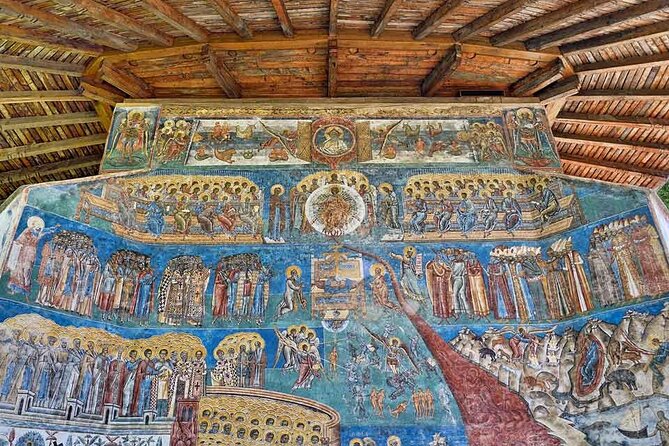
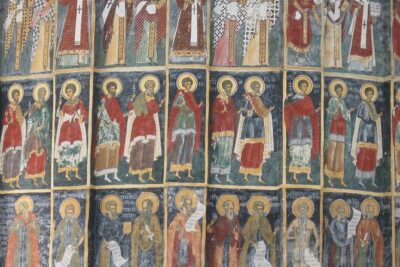
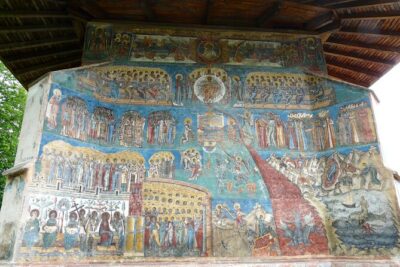
The guide can point you toward what to look for, but even on your own you’ll notice the composition around the nave and the church’s overall shape. Then there’s the Western facade fresco known as Judgment’s Day. It’s big, and it’s not shy about its message.
The other reason people talk about Voronet is color. The Blue of Voronet is often described as unique in the world, compared to other famous historical pigments like Rubens red and Veronese green. You do not need a chemistry degree to enjoy it. When the light hits the facade, the blue feels intentional, not decorative. It helps that the fresco is right where your eyes already want to land.
Voronet is scheduled for about an hour. That’s enough time to look at the facade, then step back and reframe the church as a whole. If you rush, you’ll only catch the most obvious parts. If you slow down a bit, the story and the composition start to make sense.
Again, admission tickets are not included, so treat this as your main “ticket budget” stop.
Moldovita Monastery: fortress walls and Petru Rareș
Moldovita is different. Instead of reading as mainly a church, it reads like a fortress. Thick walls about 1.20 meters and tall towers, roughly 5 meters, anchor the facade. There’s also a powerful tower for the gate, which reinforces the defensive feel.
This is where you learn that these sites were not only religious centers. In the 1500s, political power, protection, and status were all wrapped together. Founded by Petru Rareș in 1532, Moldovita pushes you to connect architecture with purpose.
The church’s fresco painting is another big selling point. It’s described by many specialists as one of the major moments of ancient Romanian art. That phrase can sound generic, but the fortress design changes how you experience the painted surfaces. You feel the contrast: severe stonework outside, and meaning inside.
You’ll have about an hour here as well. Use at least part of that hour to look at the edges and corners of the building, not only the “main” facade. The towers and wall lines shape how your eye moves, and a good guide will help you spot what those visual choices are doing.
Tickets are not included, so plan accordingly.
Sucevita Monastery: the best-kept painting and the Virtues Ladder scene
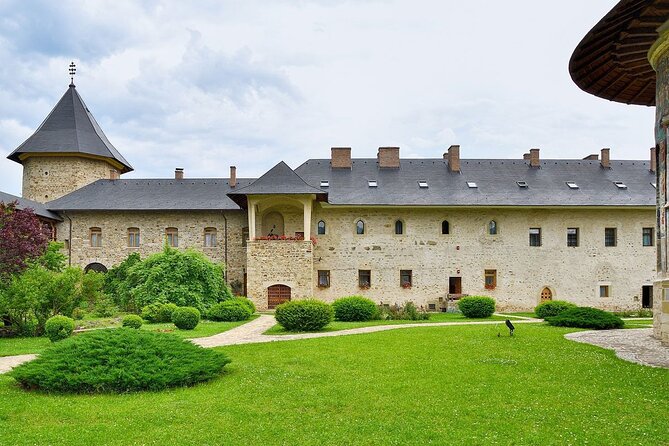
Sucevita Monastery was built in the final decades of the 16th century, funded by the Movila family, with Ieremia as ruler of Moldavia between 1595 and 1606. That family sponsorship detail matters because it explains why the church looks cared for, organized, and expressive rather than plain.
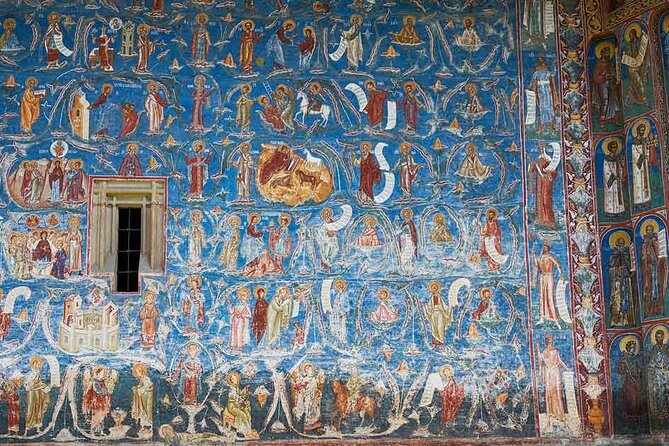
One reason Sucevita is highlighted is that its exterior painting is the best kept among this group, and it keeps its northern side. That might sound like a technicality, but it affects what you can see. If you only ever photograph facades from one angle, you miss what makes this church special. With the northern side preserved, your viewing perspective feels more complete.
The star scene is called Virtues Lather. It’s described as impressive for its size and for strong contrasts, including hell’s chaos. The scene frames a moral battle, a human attempt to reach perfection, and the consequences of falling into sin.
If your tastes run cinematic, you’ll like this stop. The fresco reads like a graphic story, with characters and structure that guide your eyes. If you prefer calmer art, take a few minutes first just to absorb the composition, then revisit the details once you’re less tense from the intensity.
You’ll have about an hour here. If you’re photographing, this is also a good place to slow down and change your position. The fresco’s impact depends on where you stand and how you angle toward the facade.
Again, entrance fees are not included.
Marginea Black Ceramics: a short taste of craft culture
After four monastery stops, the day adds a quick cultural switch: ceramics at Ceramica neagra Marginea. This stop is only about 10 minutes, so think of it as a sampler, not a full workshop.
Here’s what you’re learning during that short window. Historians date the start of pottery in Marginea to around 1500, driven by the practical need to store food. The region has the raw ingredients for the craft: clay-rich argillaceous soil, the Sucevița river, and forest resources, plus a real supply chain of tools, fuel, and know-how.
Before communist oppression, there were at least 60 pottery families. That’s the kind of detail that turns a craft stop from “look at objects” into “understand a community economy.” You’re not just buying pottery. You’re watching how local materials and local labor shaped everyday life.
Since this is 10 minutes, you should decide in advance what you want: photos only, or also buying a small item if the shop offers it. Admission is listed as free for this stop.
Price and value: where your money goes, and what to budget
At $140.43 per person, the value depends on what you’d otherwise pay in time, transport, and stress. You get:
- a professional live English-speaking guide
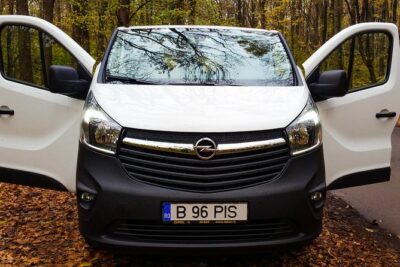
- private transportation in an air-conditioned vehicle
- parking fees included
- a structured day with multiple major sites
For me, the best value is the combination: several iconic Painted Monasteries plus a local pottery stop, all stitched together with a guide. The alternative, doing this on your own, often turns into a patchwork of transport, parking hassles, and time lost searching for the best order.
Where costs can surprise you is the items explicitly not included:
- lunch
- entrance fees
So the smartest approach is to treat $140.43 as the base cost for the guide and transport, then set aside extra for monastery tickets and any meal you choose. If you’re the type who likes to eat well during tours, plan to pay for lunch rather than expecting it built into the price.
The tour is also described as usually booked 36 days in advance. That tells me this route is popular and seats can fill, especially if you travel in peak season.
Pace, timing, and what to expect during the 7 to 9 hours
The schedule is built around a simple rhythm: drive, arrive, look, repeat. Each monastery stop is about 1 hour, which gives you time for:
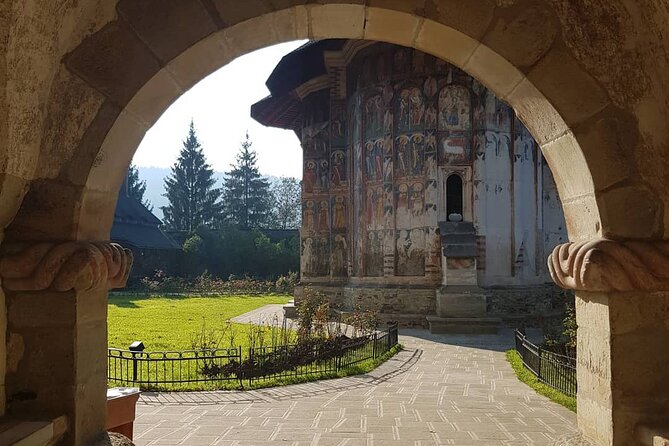
- walking around the exterior
- looking at the fresco surfaces and facade composition
- reading any on-site information if you want the text context
- taking photos without feeling like you’re racing your own bus
Marginea is the quick punctuation mark at the end, at 10 minutes.
That pacing is ideal if you’re the “I want to see the highlights but I also want to absorb them” traveler. It’s not a two-hour dash, and it’s not a slow multi-day art pilgrimage either. You come away with a coherent sense of how these monasteries relate in style and storytelling.
One practical note: bring a lightweight layer. Even with an air-conditioned vehicle, you can go from warm car to cooler church stone and outdoor hills in one day.
Who this Bucovina day trip fits best
This tour fits best if you:
- want a structured day from Suceava with minimal transport work
- enjoy fresco art, symbolism, and architectural details
- like seeing multiple sites in one go, without feeling pushed
It’s also a good fit for first-time visitors to Bucovina’s Painted Monasteries, because you get exposure to different churches with different design moods. Humor sets the scene. Voronet gives you the signature blue. Moldovita adds fortress character. Sucevita brings the dramatic moral storytelling. Marginea gives you a regional craft taste.
If you only care about one monastery or you hate driving all day, you might prefer a shorter version focused on fewer stops. But if you want breadth plus context, this is a solid match.
Quick checklist before you book
- Bring money for entrance fees at the monasteries.
- Plan for lunch spending since lunch isn’t listed as included.
- Wear comfortable shoes for walking around courtyards and viewing facades.
- Keep your camera ready for facade frescoes, but also allow time just to look.
Should you book this 1-day Painted Monasteries tour from Suceava?
I’d book it if you want the Painted Monasteries with a guide who can explain what you’re seeing, and you want the easy logistics of pickup, parking handled, and an air-conditioned ride. The biggest reason to say yes is the value blend: multiple major sites in one day, with enough time at each to actually enjoy them.
I’d think twice if you’re trying to keep costs ultra-tight, because entrance fees and lunch will add to your total. Also, if you can’t handle a long day, check your comfort level with 7 to 9 hours out in the countryside.
If that sounds like your pace, this is a great way to experience Bucovina without turning your day into a transportation project.
FAQ
Is pickup included for this tour?
Yes. Free pickup is offered from your hotel or any other address in Suceava.
Are entrance fees included in the price?
No. Entrance tickets are not included.
Is lunch included?
No. Lunch is not included.
How long is the tour?
It runs about 7 to 9 hours.
What time does the tour start?
The start time is 9:00 am.
Can I get a full refund if I cancel?
Yes. You can cancel up to 24 hours in advance for a full refund.
Everything Else We Reviewed In Romania
- Bucovina Painted Monasteries Day Tour
★ 5.0 · 83 reviews - Orsova: Danube’s Cauldrons Boat Tours with Audio Guide
★ 4.8 · 28 reviews - Bike & Wine tour in Dealu Mare wineland
★ 5.0 · 24 reviews - Private Transfer from Giurgiu Port to Bucharest
★ 4.5 · 12 reviews - Orsova: Entire Area Boat Tours with Audio Guide
★ 4.7 · 11 reviews
More Monasteries And Churches
- Bucovina Painted Monasteries Day Tour
★ 5.0 · 83 reviews - Half Day Tour to Bucovina Painted Monasteries
★ 5.0 · 6 reviews
The Painted Walls Of Bucovina
- Bucovina Painted Monasteries Day Tour
★ 5.0 · 83 reviews - Half Day Tour to Bucovina Painted Monasteries
★ 5.0 · 6 reviews
Recently added around Romania
- From Cluj: Mountain Bike around Lake Dragan★ 5.0 · 4 reviews
- Private guided tour to Craiova★ 5.0 · 5 reviews
- Half Day Tour to Bucovina Painted Monasteries★ 5.0 · 6 reviews
- Orsova: Entire Area Boat Tours with Audio Guide★ 4.7 · 11 reviews
- Private Transfer from Giurgiu Port to Bucharest★ 4.5 · 12 reviews
Bucovina Painted Monastery Tours, compared.
 ★ 5.0Bucovina Painted Monasteries Day TourFrom $10283 reviews
 ★ 5.0Day trip from Iasi to the UNESCO Painted Monasteries in BucovinaFrom $24426 reviews
 ★ 5.011-Day Romania Tour from Bucharest with Transylvania & BucovinaFrom $2,3676 reviews
 ★ 5.0Bucovina Painted Monasteries & Transylvania Tour: 4-Day PrivateFrom $1,3566 reviews
 ★ 5.0Half Day Tour to Bucovina Painted MonasteriesFrom $596 reviews
 ★ 4.56 Days Transylvania and Bukovina Small Group Tour from BucharestFrom $1,1633 reviews
 ★ 5.0Transylvania & Bucovina Private Tour – 6 daysFrom $1,4193 reviews
 ★ 5.0Two days tour to Bucovina & UNESCO Painted MonasteriesFrom $6963 reviews
Browse the lists this tour appears in